Your Sales Forecast Isn't a Data Problem. It's a Architecture Problem.
Your forecast is failing because your sales stages measure rep optimism, not buyer commitment. Fix stage exit criteria, stop overrides, then add AI and tools. Same CRM, different truth.
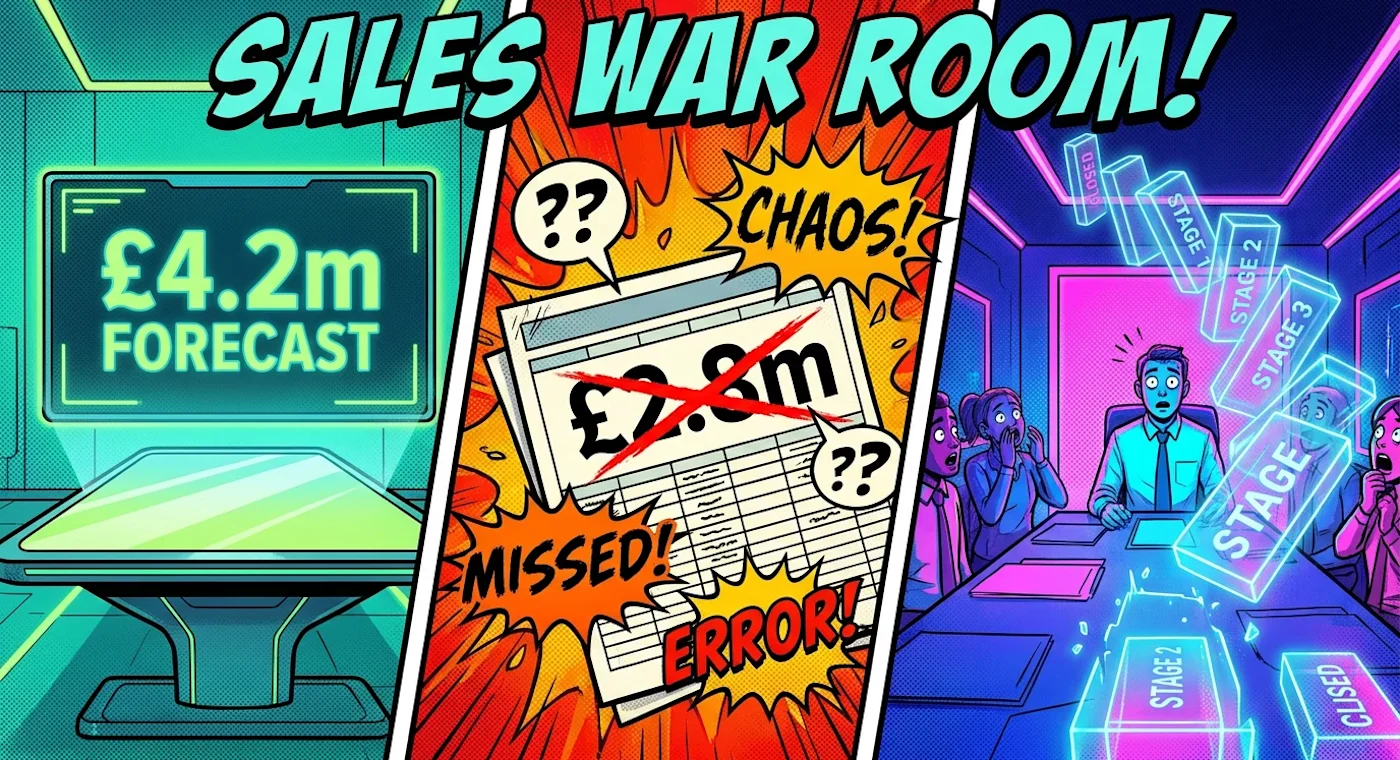
You are sitting with the board deck open. The pipeline figure your CRM produced reads £4.2m for the quarter. You already know you will present something closer to £3.1m. That gap, the one between what the system says and what you genuinely believe, is the most honest piece of data your sales forecasting process produces. And it is telling you something uncomfortable.
The gap is not noise. It is a diagnosis.
Most leaders read that compression as good judgement. You know your team. You know which reps inflate. You shave the number to protect your credibility. Sound thinking, on the surface. Underneath it sits proof that your commercial architecture has already failed. If the official system needs a human override to become trustworthy, the system has stopped producing a forecast. It hands you a starting point for negotiation.
The forecast is a design output, not a data output
The way your pipeline was built sets your forecast accuracy, long before anyone touches the records. Design your stages, exit criteria, and qualification standards around verifiable buyer commitment, and the same CRM produces tight variance. Let them evolve from a template nobody owns, and it produces fiction. The tool is rarely the variable that matters.
This is the part most people get backwards. They treat a bad forecast as a hygiene issue. They add more fields, tighten the data entry rules, and start pricing up a migration to a shinier platform. The fix never lands, because the break sits in the logic of how a deal moves from one stage to the next.
Consider what a sales stage usually measures. "Proposal sent." "Verbal yes." "60% likely." Read those again. Every one of them records what your rep hopes will happen. None records what the buyer has committed to do. A confirmed budget is a buyer action. A signed mutual close plan is a buyer action. A scheduled procurement review is a buyer action. "Feeling good about it" is not. When your stages track optimism, your pipeline records mood with a currency symbol attached.
Why the £1m to £10m band breaks forecasts on schedule
This revenue band creates a predictable failure condition. You have outgrown founder intuition, but you have not yet built the repeatable architecture a team sales motion needs. The hero remembered every stage, so the company never had to define one. The team that follows has no shared language for what "qualified" means.
There is a fair counterpoint here. Some leaders argue the market moves so fast that no architecture survives contact with a budget freeze or an acquisition. That is true at the edges. A layoff does shift win rates. But when your stages were never designed to track commitment, the win rates you build on top of them were misleading long before the market moved. Architecture will not stop the turbulence. It tells you, earlier and honestly, when a deal is exposed.
Shadow systems are a rational response, not rep rebellion
When the official CRM fails to produce commercially meaningful data, your team builds workarounds. Spreadsheets. Slack threads. A verbal forecast the sales manager carries to your one-to-one. People route around a system that does not help them do their job, and mandating compliance without fixing the architecture only drives the behaviour underground.
I sat in a pipeline review last year at a fintech scale-up, somewhere in the middle of the band. The CRM dashboard read clean. Every deal had a stage, a probability, a close date. Halfway through, the sales director pulled up a different sheet on his laptop, one nobody else had seen, and started talking from that. A £4m forecast on the screen. A £2.8m number in his private file. He nudged deals up and down deal by deal, all of it in his head, none of it written down. The reps watched him do it and said nothing, because they all kept their own version too. Two pipelines existed. One for the audience. One for the work.
That ritual is not rare. It is the forecasting system in most teams at this stage, a one-person spreadsheet posing as a process. When that person goes on holiday, the forecast does not get built.
What is breaking the forecast, stage by stage
Four mechanisms produce most forecast failure at this stage, and every one is a decision someone made, not a tool that misbehaved. Stages that measure rep optimism instead of buyer commitment. Absent or unenforced exit criteria. SDR targeting that drifts. Compensation that quietly rewards gaming. None of these acts alone. Each one amplifies the others.
The pattern is consistent enough that you can audit your own pipeline against it. When three reps can look at the same deal and place it at three different stages, your stage definitions are opinions rather than rules. Well-defined stages with clear exit criteria are one of the foundations of accurate forecasting, and mixing deal types in a single pipeline inflates the number you carry to the board.[1]
Take a worked example. You have a stage called "Negotiation." Today, a rep can drag a deal into it the moment a call goes well. No requirement to show a confirmed budget. No named economic buyer. The deal sits there at 60% because the rep feels 60%. Now rewrite the exit criterion. To enter "Negotiation," the deal must have a procurement review booked in the calendar and a written budget range from the buyer. Apply that test to your open pipeline tomorrow and watch what happens. Half the deals sitting in that stage cannot legitimately be there. Coverage that looked healthy thins out at once. That thinning is the truth arriving early instead of at quarter-end.
An exit criterion is a verifiable test a deal must pass to leave one stage and enter the next. Not "the rep thinks they are ready," but a specific buyer action you can point to. Map each common stage label to the buyer action that earns it.
Stage | Exit criterion (verifiable buyer action) |
Discovery | A named economic buyer and a documented pain with a cost attached |
Solution | A stakeholder map exists and the buyer has confirmed evaluation criteria in writing |
Negotiation | A procurement review is booked and a mutual close plan is signed |
Without these tests, your stages are labels. With them, your stages become a filter.
Run the "Solution" redesign on a real deal and the gap shows up fast. A rep tells you a £180k opportunity is in Solution, advancing nicely. You ask for the stakeholder map. There isn't one. You ask whether the buyer has confirmed the evaluation criteria in writing. They haven't. The deal was never in Solution. It was a hopeful conversation wearing a stage label, and your forecast was carrying it at full weight.
One caution on the criteria themselves. Verifiable does not mean identical across deal types. A short SMB cycle might prove commitment with a signed order form and a card on file. A six-month enterprise deal proves it through a procurement review, a security sign-off, and a named budget holder. Set the test to the buyer behaviour that actually de-risks that contract, then hold the line. The principle stays the same. The evidence changes with the deal.
Who runs the audit, and how
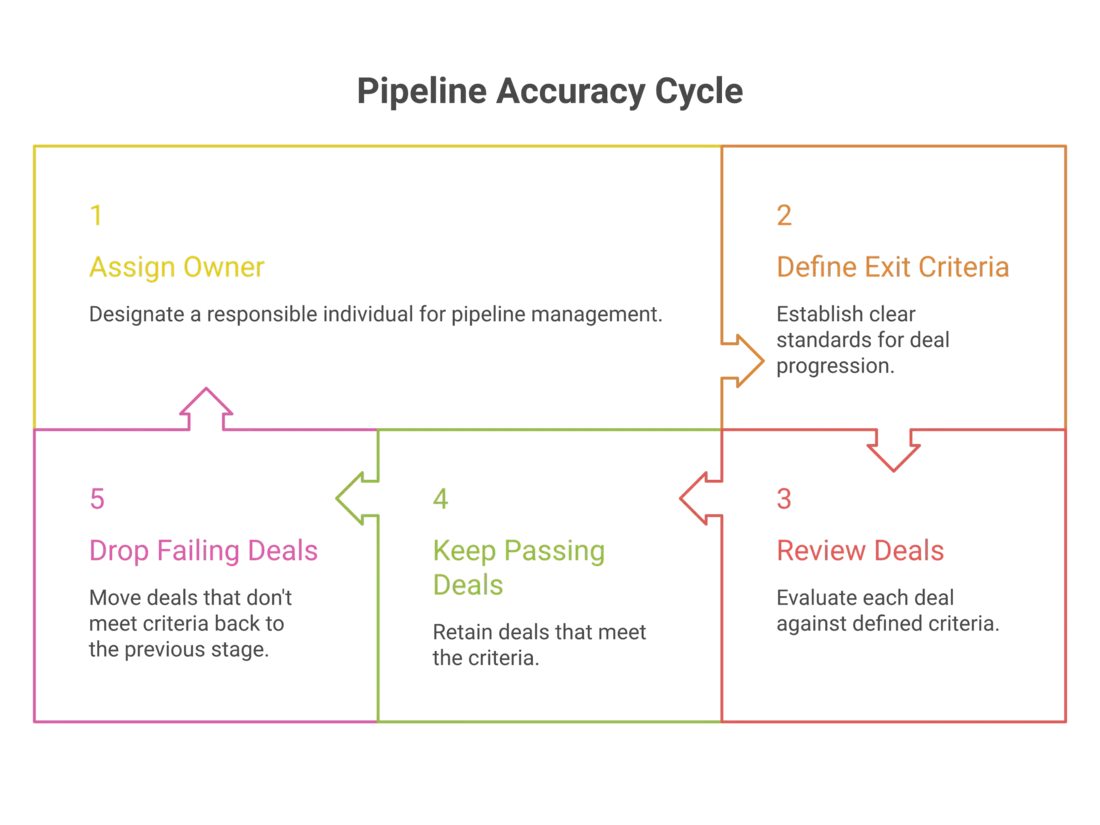
Pick one owner. Sales ops, a RevOps lead, or you if the team is small. Give that person two inputs: the written exit criteria you just defined, and read access to every open deal. They walk the pipeline deal by deal, checking each one against the stage it claims. A deal that passes stays. A deal that fails drops back to the last stage it can prove. Borderline cases go to the rep with a single question: show me the buyer action. If the rep cannot, the deal moves. This is not a witch hunt. It is the first time the pipeline has been measured against a fixed rule rather than a mood.
The same discipline decides what feeds the top. When SDR targeting slips, the pipeline fills with poorly qualified opportunities that inflate the volume and convert at nothing. Once a team can quantify the value of every call, the work stops being "spray and pray." A top of funnel that counts meetings booked rather than meetings that should have been booked poisons everything downstream.
Then there is pay. Compensate people on activity and pipeline created, and you will get activity and pipeline created, regardless of whether it converts. The incentive structure decides what your team optimises for. One practical fix worth borrowing: gate a slice of the quarterly accelerator on data quality, scored on a handful of objective lines, so a clean book pays and a padded one does not.
Same CRM, two completely different outcomes
Identical tools produce wildly different forecast variance depending on one thing: whether the lead-to-order lifecycle was deliberately designed or inherited from a template. Rep-submitted forecasts that lean on optimism and gut feel carry roughly 30 to 40% variance. Stage-based methods built on weighted pipeline tighten that to 15 to 25%, and disciplined multi-variable models reach single digits.[2] The platform did not change between those numbers. The design discipline did.
This should kill the platform-switching instinct on the spot. When the number is unreliable, the reflex is to blame the CRM and go shopping. Salesforce feels clunky, HubSpot feels light, every demo call makes the grass look greener. You migrate, spend six months on the project, and arrive at the same wide variance, because you carried the same undefined stages across to the new system. A migration moves your problem. It does not solve it.
A tool genuinely helps when adopting it forces a design decision. Stop letting deal intelligence live in fragments and you have done architecture work that happens to arrive as a software purchase. YouGov, running six-to-twelve-month enterprise cycles, replaced a mix of disparate tools and manual data collection with a single platform and reported drastically improved forecasting confidence, along with hours saved each week on manual deal follow-up.[3] Pulling everything into one place was the real fix. The platform was the occasion for it.
Why AI on a broken forecast makes it worse
Layering an AI forecasting model onto an unresolved governance problem amplifies the inaccuracy and speeds it up. The model learns from your stage data, and if your stages measure optimism, the AI now produces confident, fast, scaled optimism. Point a model at undefined stages and you buy faster fiction, not a better forecast. The sequence is the whole game: architecture first, automation second.
The pull to skip the first step is strong. Point the model at your CRM, let it call the number, remove the human guesswork. The trouble is what automation does to whatever you point it at. Aim it at a clean process and it removes repetitive work and sharpens decisions. Aim it at a vague one and it multiplies the vagueness at speed.
If your reps cannot agree on what "qualified" means, no model trained on their entries will resolve that disagreement. It will average it, dress it in a probability score, and hand you a number that looks more authoritative and is no more true. You will trust it more and be wrong more confidently.
So when is a team ready for AI on the forecast? A simple test. Could a fresh pair of eyes audit your open pipeline against your written exit criteria and reach the same verdict you would? If yes, your stage data means something, and a model has clean signal to learn from. If no, you are not ready, and any tool you buy will inherit the disagreement. Get the order right and the same tools earn their keep. Fix the stages, enforce the exit criteria, clean up who owns qualification, then bring automation in to remove the admin and surface signals a human would miss. Software does not repair a broken sales motion. It scales whatever motion you already have. Rebuild the operating system first. Embed the automation around it second. This is the sequence Zero2Five works through with scaling B2B teams, and the order never changes.
The one question that tells you if your forecast is already broken
Ask yourself this. Do you adjust the CRM number before anyone else in the business sees it? If the answer is yes, your architecture has already failed, and no amount of data cleaning, platform migration, or AI tooling will fix what is fundamentally a design problem. The override is the symptom. The design is the disease.
So here is the concrete first step, and it costs you nothing but a hard hour. Take your current pipeline. Go stage by stage. For each stage, write down the exact buyer action a deal must show to be there. Not what your rep believes. What the buyer has done. A confirmed budget. A booked procurement review. A signed mutual plan. Then check every open deal against that test.
You will be unsettled by how many deals cannot pass. That number, the deals sitting in stages they have not earned, is the size of the gap between your CRM and your gut. It is also the work. Once your stages map to verifiable commitment, the override stops being necessary, because the system finally tells you the truth.
Think about how the next review plays out. The CRM reads £3.1m. You present £3.1m. No private sheet, no mental discount, no quiet shave before the room sees it. That is what good sales forecasting looks like when the architecture underneath it was designed on purpose. Start with the stages.
Our Opinion
The override is the single most diagnostic act in any sales function, and we see it in nearly every team we work with inside the one to ten million band. The private discount a leader carries to a review is not caution. It is evidence that the stages stopped tracking buyer commitment some time ago. When we rebuild a pipeline, the first hour is rarely about data. It is about who owns the definition of qualified, because that one piece of ownership decides whether every number downstream means anything at all.
What most teams still get wrong is treating forecast accuracy as a reporting problem when it is a design and governance problem. They tighten fields, buy a new platform, then bolt a model on top and wonder why the variance holds. Our position is blunt. No team should run AI on a forecast until a second person can audit the open pipeline against written exit criteria and reach the same verdict. If they cannot, the automation does not help. It scales the disagreement faster, and you pay for the privilege.
About the Author
Mike Gallop is co-founder of Zero2Five and has spent over two decades leading B2B sales teams across SaaS, legal tech and fintech, including roles as Chief Revenue Officer at Wiserfunding and Sales Director at Fliplet. He builds repeatable sales systems, sharpens pipeline visibility and fixes forecast discipline for scaling teams. He holds a BA (Hons) in Business Management from Southampton Solent University and coaches sales leaders in his spare time.