Audit Your B2B Sales System Before You Touch AI Automation
Most AI sales forecasts fail because the CRM and stages are messy. Audit your system first, fix ownership and definitions, then automate. Otherwise you will scale confident nonsense.
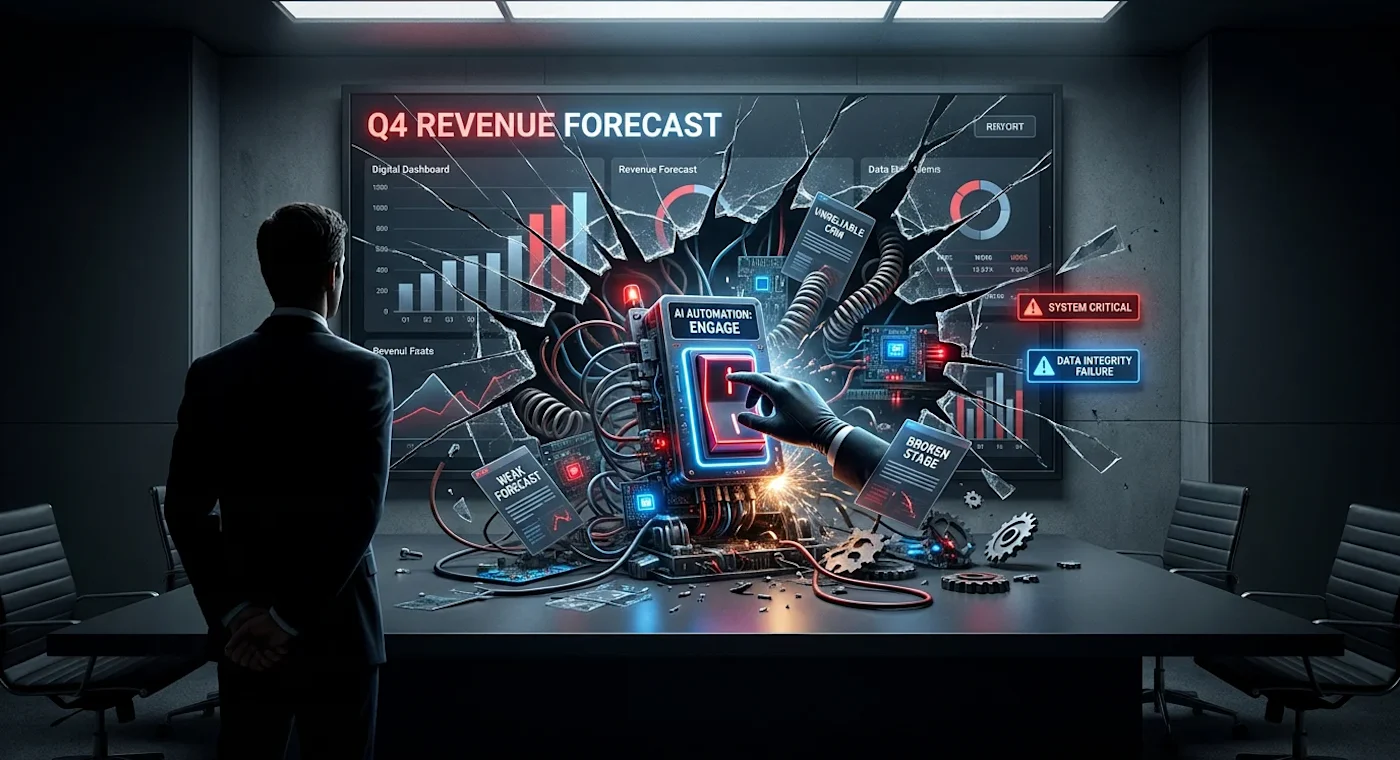
The forecast review went the same way it always does. One rep swears the deal is closing, another shrugs, and the number you take to the board is a feeling dressed up as data. The CRM still lies. The follow-up is still patchy. You are sat there weighing up whether to buy an AI tool, hire a sales lead, or migrate the CRM, and none of it touches the thing breaking the forecast.
If you switched on automation tomorrow, what would it run on?
Why automation makes a broken system worse, faster
Automation does not fix a sales process. It runs the one you have, faster. Feed it stage definitions that three reps read three different ways, and it will confidently rank deals that do not exist. Feed it contact records that are half wrong, and it will route effort to the wrong people. The AI does not know your data is rubbish. It treats every record as truth. When the inputs are inconsistent, the output is just confident nonsense produced at speed.
The numbers bear this out. AI forecasting runs 85% to 95% accurate for firms with clean, milestone-based pipelines, then collapses to 50% to 60% for firms with messy CRM data. [1] Same algorithm, opposite result. The difference is the foundation underneath it.
Alyssa Medina, VP of Support at Fathom, named the trap plainly: if you QA your human agents but not your AI outputs, you have created a blind spot for your organisation. [2] That blind spot is where the damage hides. The tool runs, scores deals nobody checks, drafts follow-ups to the wrong contacts, and the quarter closes short before anyone traces it back.
The audit: 25 questions to find where yours is broken
Before you spend another pound on tools, hires, or a CRM migration, score your own system. Answer each question with a yes or a no. Yes scores a point, no scores nothing. Get your team to answer separately. Where two reps answer the same question differently, you have found a gap that automation would only deepen.
ICP and qualification discipline
Can every rep describe your ideal customer in the same terms?
Do you have written qualification criteria a deal must meet to enter the pipeline?
Do reps disqualify deals that fail those criteria, rather than parking them?
Is there an agreed framework for scoring fit and intent?
Pipeline stage integrity
Does each stage have a written definition?
Does each stage require a specific buyer action to move forward?
Would two reps place the same deal in the same stage?
Do deals move backward when they stall, or just sit?
CRM data quality
Is your CRM updated within the same day a deal changes?
Are contact and account records accurate more than 80% of the time?
Is there a named owner for CRM data hygiene?
Can you trust a pipeline report without manually checking it first?
Are closed-lost reasons captured consistently?
Forecasting ownership
Is one named person accountable for forecast accuracy?
Do you use a defined method rather than gut feel?
Can you compare last quarter's forecast against what actually closed?
Is your forecast review a diagnosis rather than a negotiation?
Founder dependency
Can a deal close without the founder in the room?
Is the sales process documented and transferable?
Have you trained anyone else to run the full motion end to end?
Would revenue hold if the founder stepped back for a month?
Repeatable team rhythm
Do you run a consistent weekly pipeline cadence?
Is there a structured coaching loop for reps?
Do new hires follow a defined ramp plan?
Can a new rep reach full productivity without shadowing the founder?
If you only have time for a quick read, answer questions 7, 11, 14, 18 and 22 first. They carry the most signal. Then add up your points out of 25. The number matters less than where the zeros cluster. Four zeros in one section is a structural fault. Scattered zeros are a discipline problem. Both need fixing, in a different order.
Run the audit in one week
Run the scoring in one focused week. Day one, you answer all 25 alone and mark your honest gut score. Day two, your reps answer the same set blind, with no sight of yours. Day three, you sit together and compare only the questions where answers diverged.
That day-three conversation is the politically expensive part, and it is worth saying so. Reps will read a blind score as a trap if you let them. Frame it as a test of the system, not the person. The point is to find where the process lives only in someone's head, not to rank who got the most points. Say that out loud before they start, and the divergences come back honest instead of defensive.
The divergences are the map. A question where you said yes and two reps said no is a process that lives in your head, not in the team. Spend the rest of the week tracing each divergence back to the workflow behind it.
What you are looking for is concrete. Pull last quarter's pipeline export and run three checks. How many deals sat in the same stage for more than 30 days without a logged next step? How many contacts have not been touched in 90 days? How many closed-lost records have a blank reason field? B2B contact data decays at roughly 30% a year, so a stale export is not a one-off. [3] High counts in one section of the audit tell you where the zeros will cluster. Scattered across all three, you have a discipline problem, not a structural one.
What your score is telling you
Each band points to a different next move. The instinct after a low score is to fix everything at once. Resist it. Sequence beats effort here. Read your band, do the first thing, and ignore the rest until that is done.
Score | What it means | First 72-hour move | Spend, or hold |
Below 8 | Founder-dependent and unstructured. No tool will save this. | Document one full deal cycle, end to end, in writing. | Hold the CRO hire and the automation budget. Fix the motion first. |
8 to 13 | Immature. Automation here multiplies the mess. | Name one person accountable for the forecast and book a weekly pipeline review. | Buy nothing yet. A new tool accelerates inputs nobody owns. |
14 to 19 | Working but patchy. Discipline gaps will get amplified. | Rewrite your stage definitions and name a CRM data owner. | Tighten your existing CRM first. Hold off on AI scoring tools until stages are agreed. |
20 to 25 | System is largely sound. Automation will remove real friction. | List your three highest-volume admin tasks and time them for a week. Sort each into fully automated, AI-assisted with a human checking the output, or strictly human-led. | Buy workflow automation for the repetitive task. Skip a full CRM migration you do not need. |
Walk the bands from the bottom up, because that is where the hardest calls sit. A score below 8 is the founder-led company before the system catches up. The founder still closes every meaningful deal, and there is no documented process to hand over. Hiring a CRO or a sales team here adds payroll to a machine that only one person knows how to operate. Average CRO tenure runs near 18 months, and a chunk of that is leaders inheriting a job that was unwinnable before they signed: no agreed qualification, dirty data, no weekly rhythm.
So what does "a deal can close without the founder" actually require? Three things, in writing. A documented motion from first call to close, set out as what had to be true at each stage. A named owner for the forecast number who is not you. And one rep who has run a full deal end to end, unsupervised, and closed it. Until those three exist, the founder is the process, and no hire changes that.
You do not need a head of enablement to get there. You need one documented deal cycle and a weekly hour. Start by writing down one full motion, from first call to close, as a checklist of what had to be true at each stage. That document becomes the ramp plan a new rep follows without shadowing you. The coaching loop is the same weekly pipeline review, run as a diagnosis: pick two stuck deals, ask what the next buyer action is, and whether the rep can name it. You are the manager until the document can manage in your place.
Breaking that dependency is unglamorous, and it rarely goes clean the first time. One team that rebuilt a collapsing forecast tied 5% of the quarterly accelerator to a four-line data-quality scorecard: deals at the right stage with required fields filled, contacts current within 90 days, next steps logged within 48 hours, and a stakeholder map on every deal past discovery. RevOps ran it on the second working day after quarter-end and published the raw report to each rep, scores side by side, names visible to the whole team. To stop it turning into a witch hunt, disputes got a 72-hour appeal window: the rep took it to the sales manager with the analyst's notes attached, and the manager's call closed it. The first quarter, two reps lost part of the accelerator. One appealed, one did not. Word travelled. By the third quarter the scorecard ran near full. Making data quality something the reps could feel in their pay is what changed the behaviour.
That pattern repeats. In the sub-50 teams we work with, commission tied to CRM accuracy is the single change that shifts behaviour fastest, and it is also the one most leaders quietly water down by week three. When that happens, the data drifts back inside a quarter, the automations start firing on stale records, and the late-night spreadsheet returns.
Climb to the 8 to 13 band and your problem is ownership. Forecast accuracy needs a name against it. CRM hygiene does too. Until those people exist, any tool you switch on will accelerate inputs that nobody is responsible for keeping clean.
The 14 to 19 band is where most growing teams sit. You have process, but it leaks. Two reps still log the same deal at different stages, which inflates reported pipeline. Fix the definitions. Agree what each stage requires. Get the team logging the same deal the same way, and your forecast stops being a debate.
What a ready system looks like in practice
A ready system has clear ownership, defined process, and clean data before any tool goes live. The pattern shows up wherever automation pays off: the team built the structure first, then put the software on top. One firm cut forecast variance from 28% to 9% inside 120 days by fixing milestones before touching a single AI tool. [1] The tool did not deliver that. The discipline underneath it did, and the tool then made the result visible. That year, or quarter, of foundation work never shows in the headline number, which is the part most teams skip and then wonder why the tool changed nothing.
When the diagnosis runs the other way
There is a case where tooling does come first, and it is worth saying so the framework does not read as dogma. If your process is sound but your team drowns in manual admin, the bottleneck genuinely is the tool. A rep spending two hours a day copying notes into the CRM does not need a workshop on stage definitions. They need that task automated. A high score with one weak section, usually data entry or follow-up, is the signal to automate now rather than later. The honest test is simple: would a clean process survive the new volume? If yes, automate. If the volume would expose gaps you have been ignoring, the gaps come first.
Fix the system first, then automate around it
The path to AI automation for sales optimisation runs through your operating system, not around it. Work out what is broken. Sort out the process and who owns it. Put automation on top of a stable foundation, then measure what changed. Skip the first two steps and you lock your dysfunction in permanently, running faster than anyone can fix it. This is the part Zero2Five Consulting spends most of its time on: rebuilding the motion before the tooling, so the automation removes friction instead of cementing it.
So before the next demo, before the next hire, before the migration, run the audit. Score it alone. Get your reps to score it blind. Chase every divergence to the workflow underneath it. Skip that week and you will hire the next CRO into the same unwinnable job, and watch the forecast review turn back into the same argument, only faster.
Our Opinion
The week-long audit is the cheapest diagnostic a founder will ever run, and the one most skip because the day-three conversation costs something politically. We see the same thing in every sub-50 team we work with: the founder already knows the forecast is a feeling, but cannot tell whether the fix is a hire, a tool, or a habit. The score does not just tell you what is broken. It tells you what to ignore until the first thing is done, which is the harder discipline.
What the market still gets wrong is treating data hygiene as an admin chore rather than a paid behaviour. Process documents and stage definitions are necessary, but they do not survive contact with a busy quarter unless the CRM costs the rep something when it lies. We tie accuracy to commission because nothing else moves the number reliably, and we hold the line past week three when most leaders quietly water it down. If you are not prepared to make clean data felt in someone's pay, do not buy the automation. It will run on records nobody owns.
About the Author
Mike Gallop co-founded Zero2Five Consulting after two decades leading B2B sales teams across SaaS, fintech and legal tech, including CRO and Sales Director roles at scaling technology businesses. He helps founders and sales leaders fix the operating system behind the forecast: pipeline integrity, CRM discipline, and repeatable team rhythm. A Southampton Solent business management graduate, he still keeps a side bet on which deal slips first.